
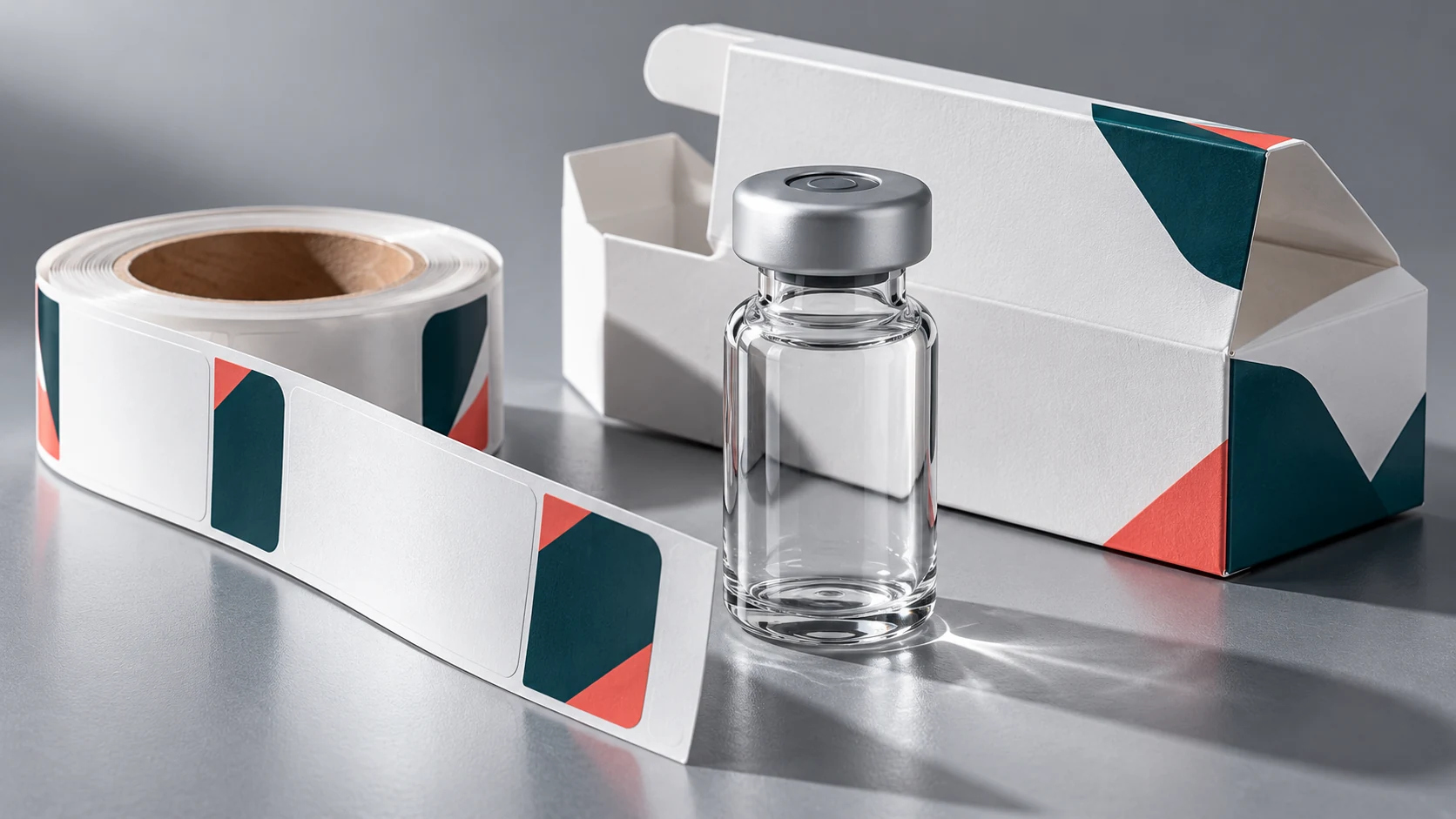
What must be approved before label printing?
Approve the exact product name, quantity basis, batch fields, intended-use wording and artwork revision. Attractive packaging cannot compensate for an incomplete specification.
Design the label around accurate information
A research vial label should be legible and consistent with the approved material specification. Include the material name, batch identifier, quantity basis and the handling information required for the agreed use. The phrase “For research use only” should remain visible and should not be contradicted by medical treatment claims elsewhere on the packaging. A compact label still needs a clear hierarchy.
Avoid adding purity percentages, certification marks, origin claims or storage conditions merely because they appear on a reference image. Each statement must be supported for the actual product and supplier. The vial concepts on this website use an unbranded navy-and-amber system to demonstrate that hierarchy; they are not photographs of released stock. CBL-514-related artwork also requires particular care because a development name and a familiar vial format do not establish authorization, formulation equivalence or suitability for clinical administration.
Approve the physical and written specification together
An artwork proof should be reviewed at its intended print size, not only as an enlarged screen image. Check line breaks, contrast, small text and how the label sits on the chosen container. Confirm that batch and date fields can be applied consistently and that barcodes, if used, remain readable. Review the carton and any insert against the same approved claims.
The physical prototype helps identify issues that a flat design cannot show, such as label overlap, closure fit or abrasion during handling. Record approval of both the artwork revision and the packaging components before authorizing production. If the material specification changes, revisit the relevant label fields rather than automatically reusing an older design. Our OEM process includes these decision points as project requirements. It does not substitute a visual approval for analytical release or imply that a packaging vendor can confer product rights or regulatory status.
Frequently asked questions
What information belongs on a research vial label?
Use the correct material name, quantity basis, batch identifier and relevant storage reference, with the statement For research use only. Actual label fields should match approved records; illustrations are not batch evidence.