
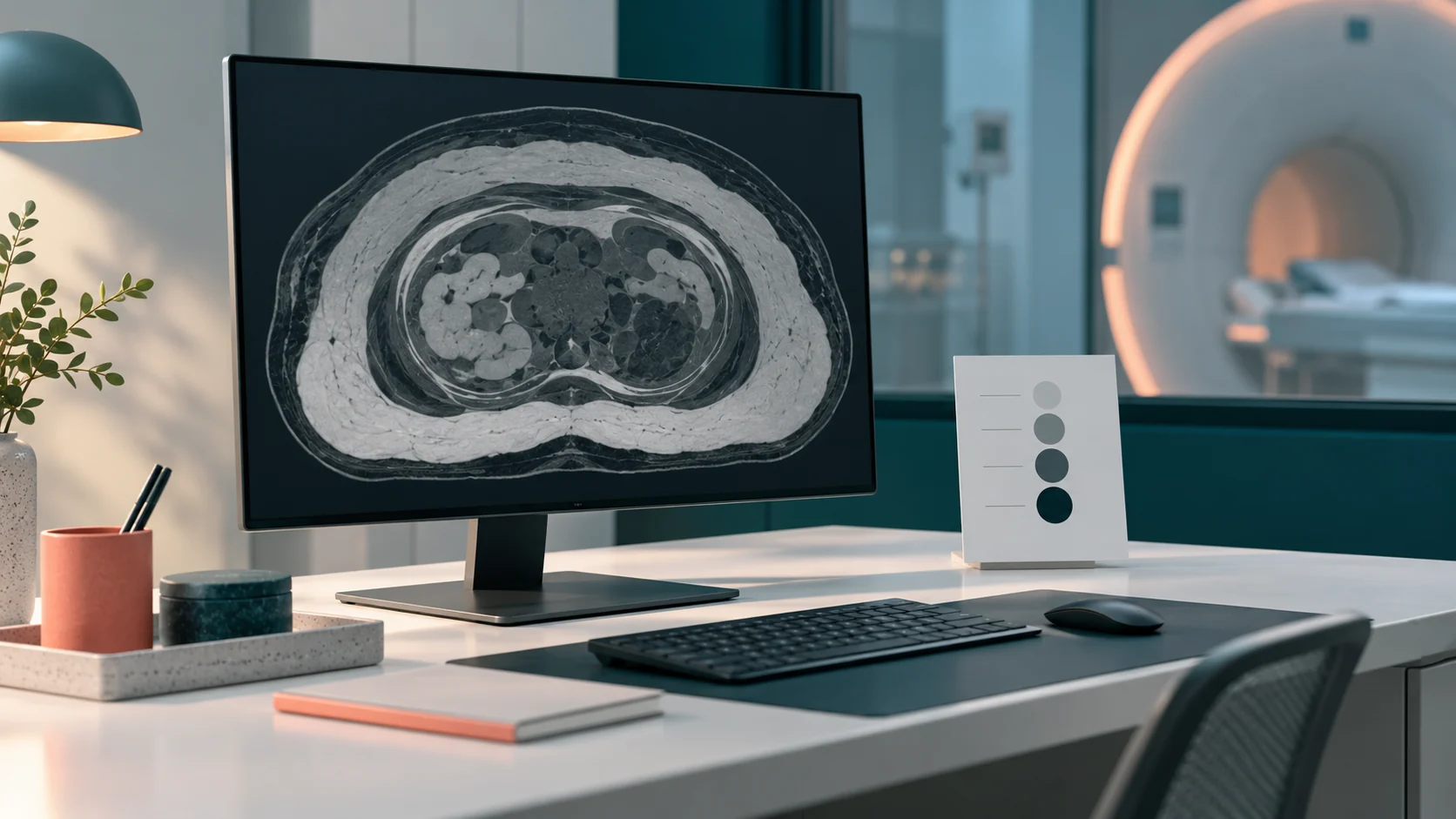
Direct answer. The 2026 Phase 2b study used a clinician rating as its primary endpoint and assessed participant ratings and MRI separately. A one-grade change and a millilitre change are different outcomes.
Three measurements, three questions
The 2026 Phase 2b publication describes a randomized, single-blind, placebo-controlled study in adults with moderate or severe abdominal subcutaneous fat. Its primary question was whether a participant improved by at least one grade on the Clinician-Reported Abdominal Fat Rating Scale (CR-AFRS) at the 12-week follow-up. The registered record, NCT05736107, defines this as a five-point ordinal scale. A participant-reported version, PR-AFRS, asks a related but distinct question: how the participant rates the change. MRI addresses measured abdominal subcutaneous fat volume and thickness, rather than a rating of appearance.
The paper reports 23/30 (76.7%) versus 7/37 (18.9%) for its primary analyzed groups. Its MRI analysis reports a least-squares mean volume change of −152.9 mL from baseline in the active group. Preserve the denominator, comparator, follow-up and analysis definition beside either number. The study figures describe the investigational formulation and enrolled participants; they are not a specification or predicted result for a separately supplied vial.
Evidence check
- Primary endpoint: clinician-rated improvement of at least one grade at 12 weeks.
- Secondary measures: participant rating and MRI-assessed abdominal fat.
- Scope: study population and analyzed groups, not a universal outcome.
Why an imaging result cannot replace a rating
An MRI-derived volume is expressed in millilitres; a five-point rating is ordinal. Those units cannot be converted into one another by a simple percentage. A participant may have a measurable volume change without crossing a scale threshold, while a one-grade scale change does not specify how many millilitres changed. The registered outcome list also gives different assessment windows for some secondary measures. When a web summary says only that a study “worked,” it erases the endpoint, timing and threshold that give the claim meaning.
Earlier CBL-514 research used other methods. In the 2025 Phase II report, ultrasound at four abdominal points supported its fat-volume calculation, and the primary response threshold was at least 150 mL. The 2026 Phase 2b paper instead centers a clinician-rated grade and adds MRI. These are separate trials with different outcome definitions. Compare methods and populations before comparing percentages, and return to the original figure or table when a secondary result is quoted.
Evidence check
- Use the trial ID and publication DOI when quoting an endpoint.
- Keep the measurement unit and assessment week with every result.
- Do not infer individual treatment effects or batch identity from study averages.
A practical reading sequence for the 2026 result
Begin with the registry primary outcome, then read the paper’s methods and results for the same endpoint. Record which participants were randomized and which contributed data to the reported analysis. Check whether clinician and participant scales were collected at the same visit, whether MRI describes a mean change or a responder threshold, and what the placebo group showed. The distinction matters when a single graphic combines a rating percentage with an imaging volume: they are complementary observations, not two independent confirmations of the same numerical effect.
Finish with safety, exclusions and follow-up. The abstract describes mainly mild, transient local reactions, but an abstract cannot replace the full adverse-event table or establish long-term safety. The published paper and registry are authoritative for the studied program; neither verifies an unrelated seller’s material. For a documented research enquiry, keep clinical evidence beside, but separate from, material-specific specifications. This distinction prevents a study outcome from becoming an unsupported product claim.
Evidence check
- Record the exact endpoint and analysis population.
- Record treatment and placebo values with follow-up time.
- Keep clinical findings separate from supplier batch documentation.
Reviewed 23 October 2026. This editorial article describes published research and documentation boundaries, not treatment or administration advice. The clinical development program is independent of this website.
Frequently asked questions
Is the CBL-514 MRI number the primary endpoint?
No. In NCT05736107, the primary endpoint is at least one-grade improvement on the clinician-reported abdominal fat scale at 12 weeks. MRI-assessed change is a separate outcome. Read both with their time points and analysis populations.
Does a one-grade change equal a fixed fat volume?
No. The rating scale is ordinal, while MRI volume is measured in millilitres. The published study reports them separately and provides no universal conversion from a grade to a volume.
Can the 2025 and 2026 response percentages be compared directly?
No. The 2025 study used an ultrasound-based volume threshold; the 2026 primary endpoint used a clinician rating. Their populations, follow-up and analyzed denominators also differ.
Does a clinical MRI result identify a purchased vial?
No. Trial measurements concern the formulation administered in that study. A separate material requires its own identity and batch evidence.