
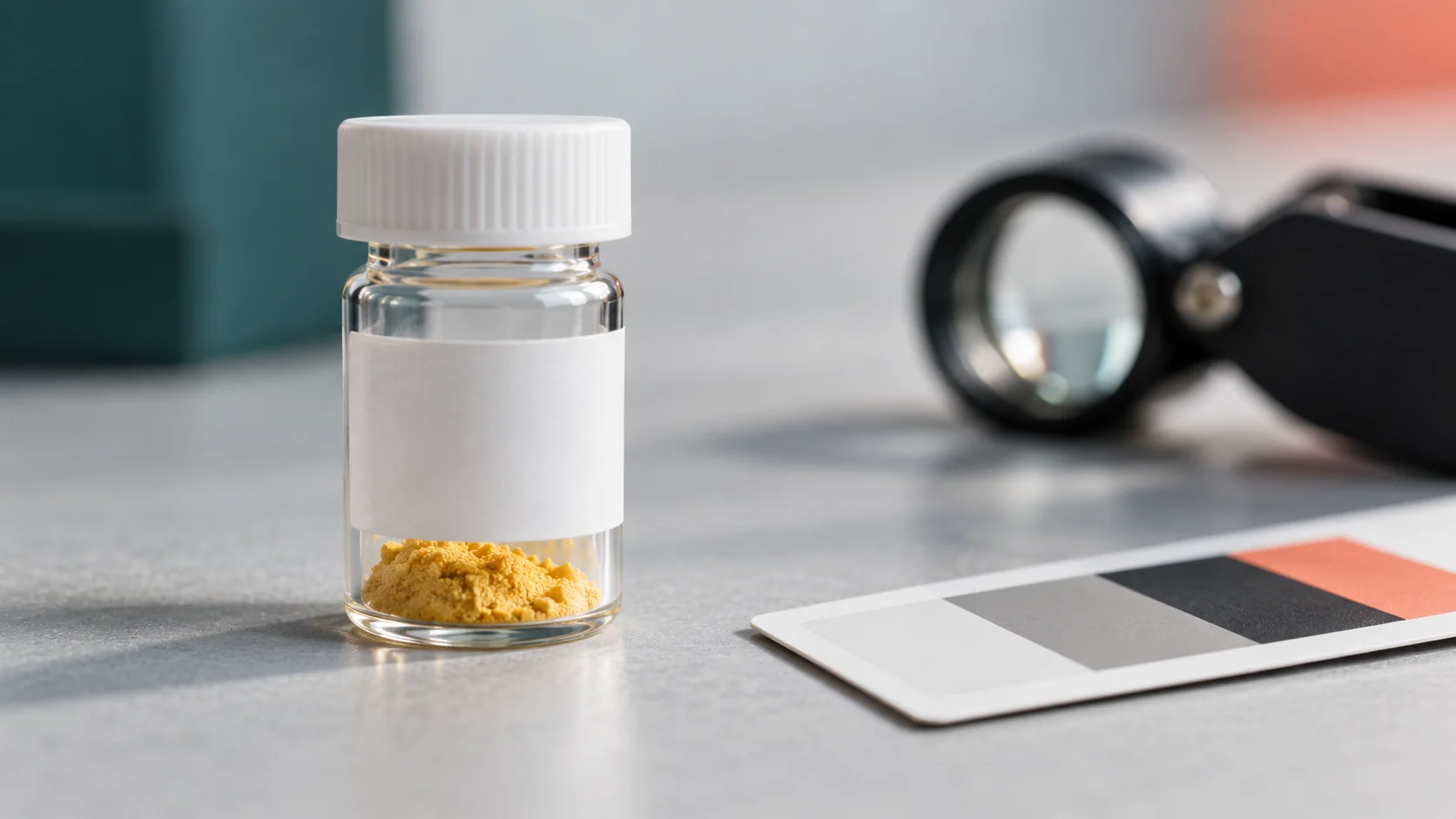
Direct answer. No. A photo can show vial format, visible color and printed label claims. It cannot establish chemical identity, amount, purity, sterility, source or equivalence to the investigational CBL-514 formulation.
What the owner-supplied photographs actually show
The product dossier includes owner-supplied real-item photographs showing yellow to golden-yellow material in vials and packaging labelled with nominal amounts. Those images are useful for describing the visible presentation and for checking that a quoted label matches the delivered package. The visible color should be represented accurately in site imagery. It remains an observation under a particular camera, light and container; no reference color range or acceptance criterion has been established here.
A photograph has no direct measurement of molecular identity or vial content. The label can be read, but the printed amount is a claim until tied to a batch-specific analytical result. The photos also do not show the legal supply chain, formulation composition or relationship to Caliway’s investigational program. Treat apparent color, fill and packaging condition as inspection notes. If a batch arrives with an unexpected appearance, ask the supplier to investigate against its controlled specification rather than trying to diagnose the difference from an internet image.
Evidence check
- Visible: approximate color, container, cap and printed label.
- Not established: identity, assay, purity or clinical formulation equivalence.
- Follow-up: request the batch number, controlled specification and test report.
Match each claim to the evidence that can support it
An identity question calls for an appropriately designed analytical procedure, reference material and traceable sample record. The ICH Q2(R2) guidance discusses validation characteristics including specificity and selectivity for identification. It does not certify any CBL-514 vial. A separate assay addresses how much of a specified component is present, while a chromatographic area percentage may describe something else entirely. The site’s purity-versus-assay guide details that distinction.
The FDA-hosted ICH Q7 guidance places visual examination of labels and containers alongside, rather than in place of, identity controls in its defined manufacturing context. That guidance is not a certification of this independent site or its suppliers. For an enquiry, ask which exact batch was tested, who issued the report, what the method measured and whether the vial shown belongs to that batch. A certificate image without a verifiable link to the offered material leaves the main question open.
Evidence check
- Appearance: dated receiving inspection or photographs.
- Identity: batch-linked analytical evidence and method.
- Content: assay with a stated unit and calculation basis.
Keep the clinical and commercial identities apart
The peer-reviewed 2025 Phase II paper describes CBL-514 as an investigational small-molecule injection product. Its results relate to the formulation and protocol in that research program. An independently offered research vial with the same development code does not inherit the paper’s identity, composition, safety profile or measured effects. That is why the product dossier distinguishes supplied photographs from established clinical facts. A nominal 10, 20 or 50 mg label is a packaging claim, not evidence of trial-supply equivalence.
For a buyer’s record, keep the seller’s legal entity, quotation, package photograph, batch report and independent testing decision together. Resolve conflicts between label and COA before relying on the material. Record what remains unverified explicitly, including availability or manufacturing authority when supporting evidence is absent. This approach allows the photographs to do a useful job without turning them into a visual certificate. It also protects the meaning of the clinical publications: they describe studied participants and measured outcomes, not the contents of an untested third-party vial.
Evidence check
- Separate the developer’s clinical evidence from seller evidence.
- Tie every test result to a specific proposed batch.
- Do not use research imagery as treatment or identity proof.
Reviewed 23 October 2026. This editorial article describes published research and documentation boundaries, not treatment or administration advice. The clinical development program is independent of this website.
Frequently asked questions
Does yellow powder prove the vial contains CBL-514?
No. The owner-supplied photographs establish a visible appearance in those packages. Chemical identity requires an appropriate batch-linked analytical method and reference, not a color match.
Does a 20 mg/vial label prove 20 mg of active material?
No. It states a nominal amount. Confirm what the unit describes and request a relevant assay report for the actual batch before treating the number as measured content.
Can a clinical paper verify a supplier vial?
No. The paper describes the formulation used in its clinical study. A separate seller must support its own substance definition, batch identity and authority; a shared name is insufficient.
Are the image on this page and the site’s real-item photos the same kind of evidence?
No. This page’s cover image is an editorial image. The product dossier shows owner-supplied photographs of actual packages, but those too are visual evidence only, not an analytical certificate.