
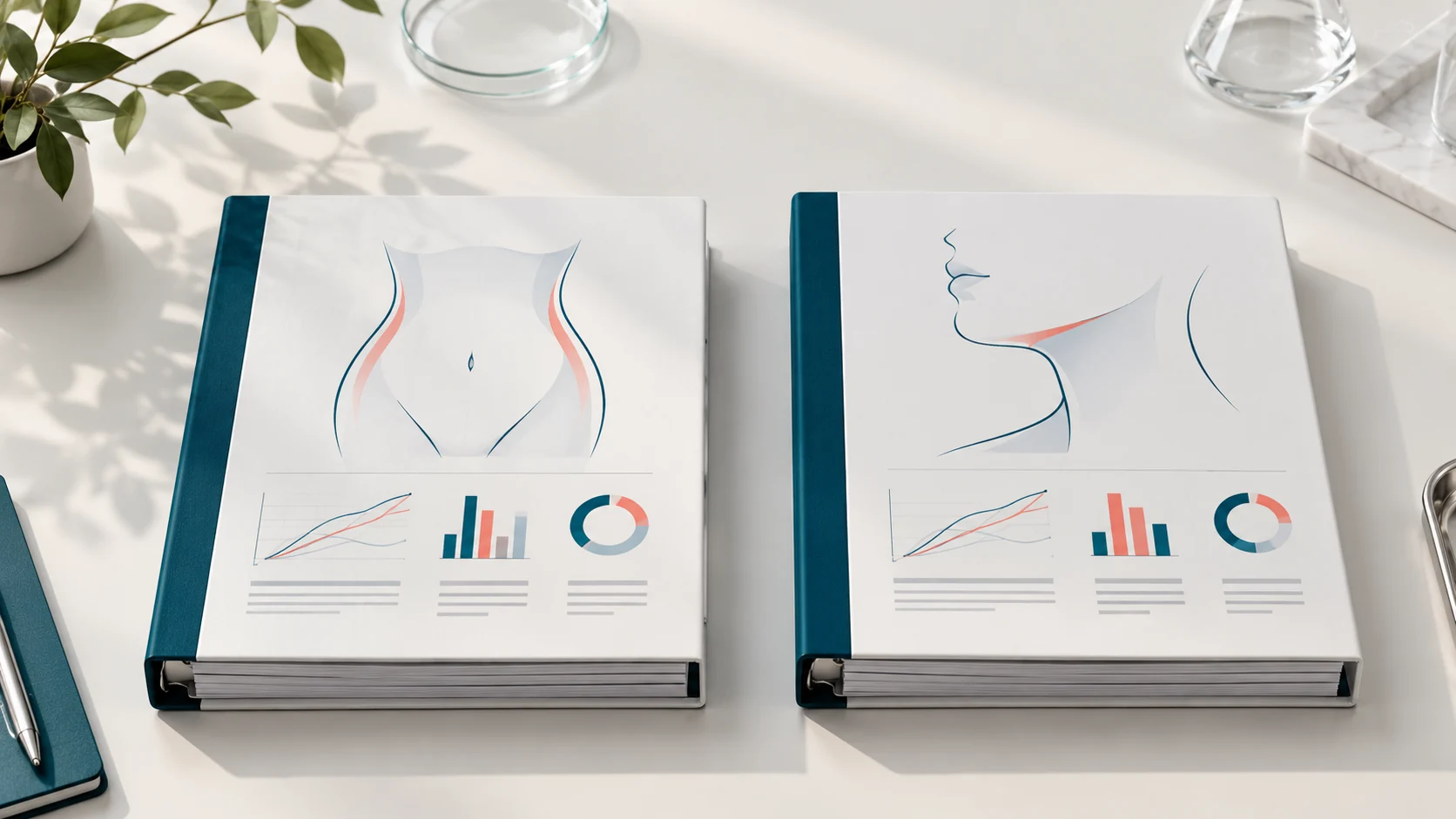
Direct answer. No published head-to-head trial in the cited evidence establishes that CBL-514 is more or less effective than deoxycholic acid. The CBL-514 abdominal studies and the FDA-approved deoxycholic-acid label concern different treatment areas, endpoints and populations.
Availability update (30 October 2026). Caliway states that its investigational CBL-514 is not commercially available and that it has not authorized any third party to supply, distribute, market or sell it. A third-party vial claim is not evidence of access to the developer’s clinical material or approval to sell it.
The two evidence files address different anatomical areas
The 2026 CBL-514 Phase 2b paper studied adults with moderate to severe abdominal subcutaneous fat. Its primary endpoint was at least one-grade improvement on a clinician-reported abdominal fat rating scale at a 12-week follow-up. The FDA label for KYBELLA (deoxycholic acid) describes an approved product for improvement in the appearance of moderate to severe convexity or fullness associated with submental fat in adults. Abdominal and submental fat are different study settings; an approved indication in one area does not transfer to the other.
The FDA label reports deoxycholic-acid studies using clinician and subject ratings of submental fullness. The CBL-514 publication reports abdominal rating and MRI outcomes. Their scales, assessment windows and enrolled groups do not form a common numerical comparison. A table may place the sources side by side to show what each measured, but it must not turn percentages from separate trials into a ranking of effect. The cited publications contain no randomized direct comparison between these two agents.
Comparison fields to preserve
- CBL-514 source: abdominal Phase 2b trial, NCT05736107.
- Deoxycholic-acid source: current FDA prescribing information for submental use.
- Missing comparison: a common population, site, endpoint and randomized head-to-head design.
Mechanism descriptions do not establish clinical superiority
The CBL-514 papers describe an investigational small-molecule agent and discuss adipocyte apoptosis. The 2025 randomized Phase II report also includes exploratory findings about local tissue response. By contrast, the FDA label calls deoxycholic acid a cytolytic agent and describes physical destruction of cell membranes after submental injection. Those are the developers’ and regulator’s descriptions of their respective products, obtained in different evidence packages. A mechanism statement is not itself a measured patient outcome.
Cell-death terminology can vary with experimental conditions and assay choice. It is especially unsafe to infer that one clinical agent has fewer adverse effects because one summary uses “apoptosis” while another uses “cytolysis.” Read the actual safety tables, follow-up and treated population in each source. The CBL-514 safety review keeps event counts beside their denominator. The KYBELLA label has its own warnings and adverse-reaction data for its approved use. Neither source verifies the contents of an independently supplied CBL-514 research vial.
What a mechanism can establish
- Identify the material and formulation studied in each source.
- Read adverse events and warnings within each study or label.
- Do not infer comparative safety from a mechanism phrase.
How to write a defensible comparison
Begin with a narrow question: approval status, studied anatomy, endpoint or reported adverse events. Give the publication date and trial identifier for a CBL-514 claim, and the label revision for a deoxycholic-acid claim. State the exact outcome and its denominator before discussing whether it resembles an outcome in another study. If the endpoint or population differs, say that a quantitative cross-trial comparison is not supported. A narrative comparison can still help a reader locate the right documents and see which questions remain unanswered.
Keep procurement evidence on a separate track. CBL-514 is described as a small molecule in the clinical papers, despite the search phrase “CBL-514 peptide.” A seller’s label, color or nominal fill does not prove equivalence to the sponsor’s formulation. The identity guide and product dossier explain what is documented and what needs batch-level confirmation. This website is independent of the clinical developer and provides research procurement information, not treatment selection or administration guidance.
A publishable comparison checklist
- Quote an outcome with trial, site, time point and denominator.
- Do not rank efficacy across unrelated trials.
- Separate published clinical evidence from a supplier batch record.
Reviewed 31 October 2026. This independent editorial page describes published evidence and research-procurement documentation. It does not provide treatment, preparation or administration advice. Verify current source versions before relying on a changing clinical or regulatory record.
Frequently asked questions
Is CBL-514 the same substance as deoxycholic acid?
No. The published CBL-514 program and the FDA-labeled deoxycholic-acid product are distinct agents. A shared interest in local fat does not establish chemical or formulation equivalence.
Has CBL-514 been tested head to head against KYBELLA?
The cited CBL-514 papers and FDA label do not report a randomized direct comparison. Their outcomes cannot be used as a superiority ranking.
Does FDA approval of deoxycholic acid cover abdominal fat?
The cited FDA label specifies moderate to severe submental fullness in adults. It does not establish an abdominal indication.
Can these clinical sources verify a research vial for sale?
No. Clinical publications and labels describe their own studied or approved products. A separate research material needs its own identity and batch documentation.