
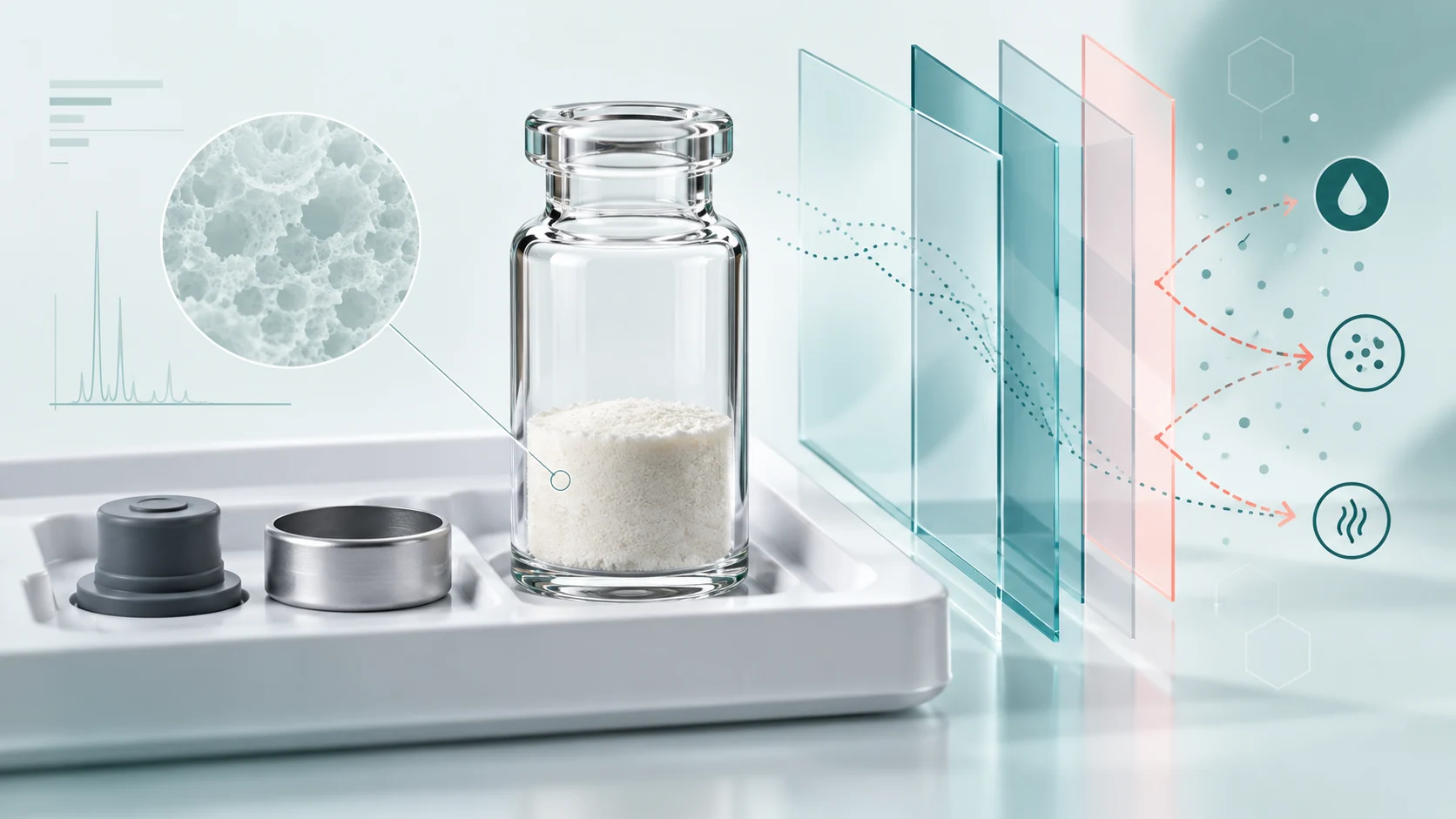
Direct answer. A good-looking vial is only a visual observation. A defensible packaging claim identifies the glass, stopper and seal configuration, the powder and fill specification, and stability data generated in the intended container-closure system under defined conditions.
Describe the complete container, not only the vial
For a lyophilized research-powder project, record the vial material and size, stopper formulation, crimp or cap, secondary pack and label format. Each component can affect moisture ingress, extractables, light exposure, handling and the ability to connect a finished lot with its test record. A photograph can show an apparent closure and fill, but not container integrity, sterility or chemical stability. The ICH Q1A(R2) stability guideline says formal drug-product stability studies should use the proposed container-closure system, with relevant secondary packaging and label as appropriate.
Q1A(R2) concerns drug-development submissions; it does not certify a research vial on this website. Its principle still exposes a common documentation gap: stability measured in one pack cannot silently support a different stopper, vial size or shipping configuration. Ask for the exact configuration used in each study and a change record when components are substituted. For an OEM brief, confirm whether “10 vials per box” describes packaging quantity, while “mg per vial” describes a separate nominal fill requiring batch-specific measurement.
Container fields to request
- Record glass, stopper, seal, secondary pack and label.
- Tie stability data to the tested configuration.
- Keep packaging quantity distinct from measured content.
Match light and moisture claims to tests
ICH Q1B recommends a structured photostability assessment for new drug substances and products: material may be tested exposed, then in immediate and marketing packaging as needed. Results include appearance and suitably measured assay or degradants. A dark vial or opaque box may reduce exposure, but appearance alone does not prove protection. Likewise, a dry-looking cake does not give a water-content number or show that a stopper maintains a suitable barrier over a stated period.
A useful research-material review pairs a defined environmental challenge with the right analytical result: water content where moisture matters, identity and assay where chemistry can change, impurity profile where degradation is possible, and physical appearance as an observation. The method and acceptance criterion should be stated before a pass is claimed. ICH Q6A separates identification, assay and impurities in its regulatory scope. Research buyers can ask the same distinct questions without implying that the offered item has been qualified as a drug product.
A claim-to-test matrix
- Protection question: light, moisture or temperature.
- Test result: measured attribute, method and acceptance criterion.
- Scope: tested pack, duration and conditions.
Do not turn a storage statement into a shelf-life guarantee
A storage instruction and a supported shelf life are different. The former may be a precaution; the latter requires time-point data, a stability-indicating method and the exact pack. ICH Q5C discusses stability profiles for biotechnological and biological products, including container effects and the need to assess reconstituted freeze-dried products when such directions are proposed. Its product scope is specific; it should not be applied automatically to every synthetic peptide, lyophilized powder or CBL-514 small-molecule material.
For an OEM enquiry, ask which material, lot and pack underpin the stated temperature, light protection and expiry. Note any excursion study separately from routine storage. If data are absent, state that the proposed condition is unverified for the offered batch. A shipping plan can then request monitoring or a defined excursion decision. None of this establishes sterility, safe reconstitution or suitability for human or veterinary administration; those require distinct evidence and authorization outside a research procurement article.
Before using an expiry claim
- Identify lot, pack and study time points.
- Request stability-indicating results, not a temperature slogan.
- Treat reconstitution, sterility and clinical use as separate questions.
Reviewed 31 October 2026. This independent editorial page describes published evidence and research-procurement documentation. It does not provide treatment, preparation or administration advice. Verify current source versions before relying on a changing clinical or regulatory record.
Frequently asked questions
Does a sealed vial prove sterile contents?
No. A visible seal is packaging evidence, not a sterility test or proof of an appropriate manufacturing process.
Can a storage temperature be copied from another peptide?
No. Conditions and duration should be supported for the specific material, formulation and container configuration.
Does the color of lyophilized powder prove identity?
No. Appearance can trigger an investigation, but identity and content require appropriate batch-linked analytical evidence.
Is this page a reconstitution guide?
No. It discusses research-packaging and stability documentation only. It provides no preparation or administration instructions.