
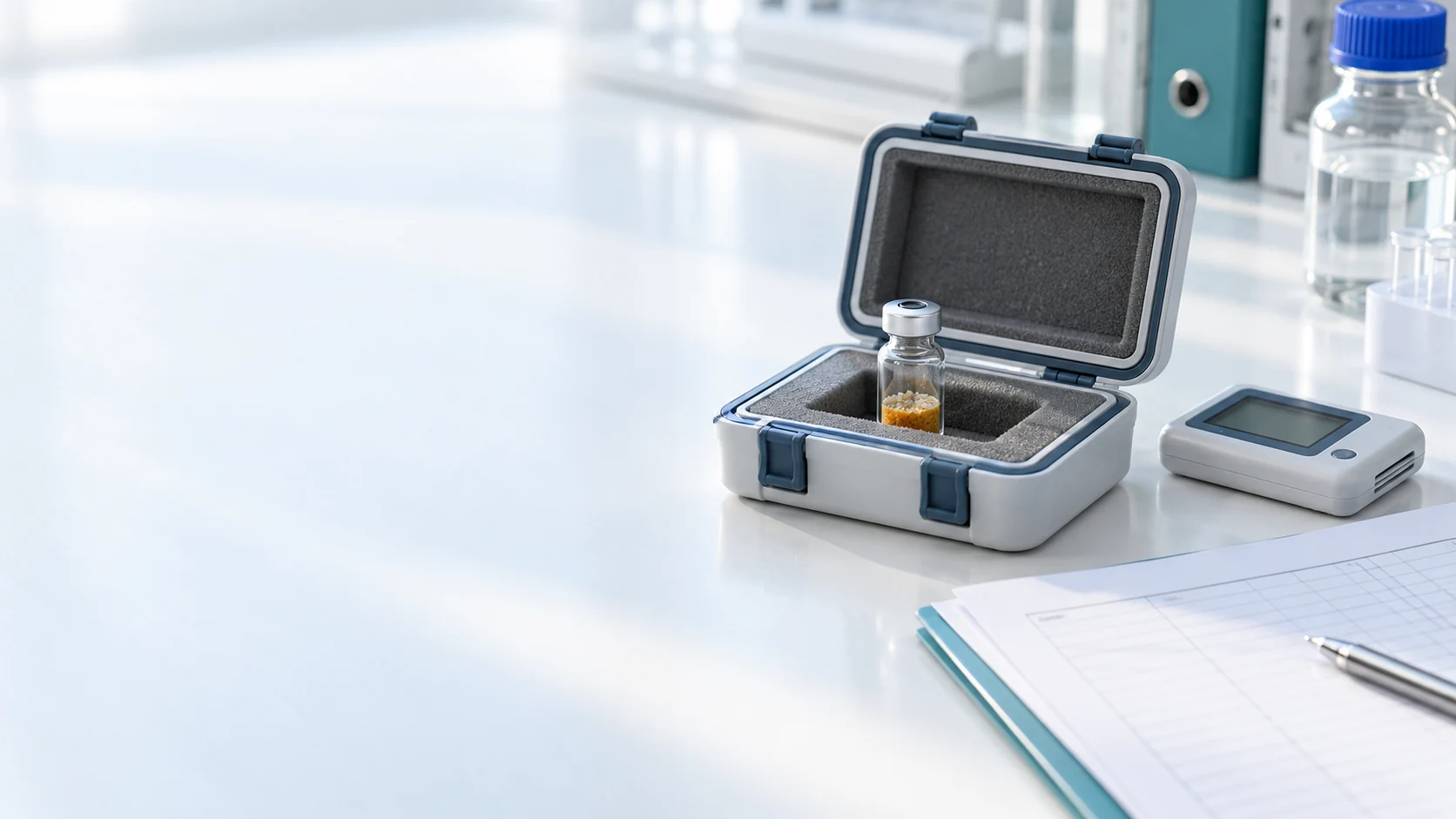
Direct answer. No public photograph or CBL-514 trial record establishes the shelf life of an independently offered vial. A defensible storage instruction needs material-specific stability data in the actual container, with defined tests, time points and acceptance limits. The developer also says its investigational formulation is not commercially available.
What can public CBL-514 sources tell us about storage?
The published abdominal Phase II study describes a sponsor-controlled investigational formulation and clinical procedures. It is not a stability protocol for an unrelated research vial. A photograph of pale or yellow material, a nominal milligram amount and a “for research use only” label cannot reveal composition, water content, degradation rate or the effect of a different closure. The same name on two packages does not establish that they contain the same substance. Caliway’s 30 October 2026 statement says its investigational CBL-514 is not commercially available and that no third party is authorized to supply it.
For a separately identified research material, the practical question is narrower: what storage range and review period has its own maker actually supported? Ask for a batch-linked specification, the proposed container-closure system and stability results in that configuration. If those are unavailable, a web page should not infer a freezer temperature, expiry date or shipping tolerance from the clinical program or from appearance. The vial-photo guide explains the identity boundary; stability is another question requiring its own measurements.
Questions a product photo cannot answer
- What material and formulation does the specific batch contain?
- Which container and closure were included in the stability study?
- What test result supports the stated temperature and review period?
What should a stability package measure and document?
The ICH Q1A(R2) guideline sets a framework for stability testing of new drug substances and products: studies should track attributes likely to change during storage and affect quality, safety or efficacy. Its design considers the proposed container-closure system, storage conditions, time points, batches and test methods. That is a regulatory framework, not a ready-made CBL-514 temperature instruction. The newer FDA Q1 revision is a draft as of this review; do not describe it as an approved product specification.
A research-material record should identify the batch and test method, then show time-point results for identity, assay or content, relevant degradation products and physical attributes. Moisture, reconstitution behavior or microbial attributes may matter according to the actual material and intended nonclinical study, but a generic checklist cannot prove they were tested. Record the sampling dates, storage logger data, acceptance criteria, analytical method version and container type. A certificate issued only at release is a starting value; it does not demonstrate that the batch remained within limits throughout a proposed storage period.
Minimum record fields
- Batch identifier, formulation and packaging configuration.
- Stability time points, test methods, results and acceptance limits.
- Traceable temperature history and documented deviations.
How should a temperature excursion be handled?
An excursion is a documented departure from the supported range, not an automatic proof of failure or safety. Keep the logger trace, maximum and minimum temperatures, duration, packaging configuration and the point in the shipment where the deviation occurred. Compare those facts with a qualified excursion study or a material-specific stability assessment. ICH Q1A(R2) discusses short-term excursions for some proposed storage conditions, but its example conditions cannot simply be copied onto an unidentified vial. If the necessary data are missing, quarantine the material for review rather than guessing from color or whether the powder still looks dry.
The FDA’s expiration-date guidance ties storage and dating claims to supporting stability testing. For this site, the boundary is straightforward: publish only batch- and formulation-specific evidence that can be checked, and label unknown conditions as unknown. A shipping plan, a release certificate and a storage study answer different questions. Our shipping checklist covers transit records; the lyophilized-powder guide covers broader material questions. Neither substitutes for a CBL-514-specific stability dataset.
Excursion review sequence
- Preserve the uninterrupted logger and shipment record.
- Match the event to a qualified study for the same material and package.
- Document a disposition decision; do not infer one from appearance.
Reviewed 31 October 2026. This editorial review summarizes named public sources and does not offer treatment or identify any third-party vial as the developer’s clinical formulation.
Frequently asked questions
Does yellow powder prove a CBL-514 vial is stable?
No. Appearance alone does not measure identity, content, degradation or time-dependent quality.
Can the clinical trial tell me how to store a third-party vial?
No. The published trial does not establish the formulation, packaging or stability profile of an independently offered material.
Is an expiry date valid without stability data?
A defensible dating claim needs stability evidence tied to the actual material, container and test criteria; a release certificate alone is insufficient.
What should be recorded after a temperature excursion?
Keep the logger trace, duration, extremes, package and batch details, then compare the event with supported excursion data before deciding disposition.